

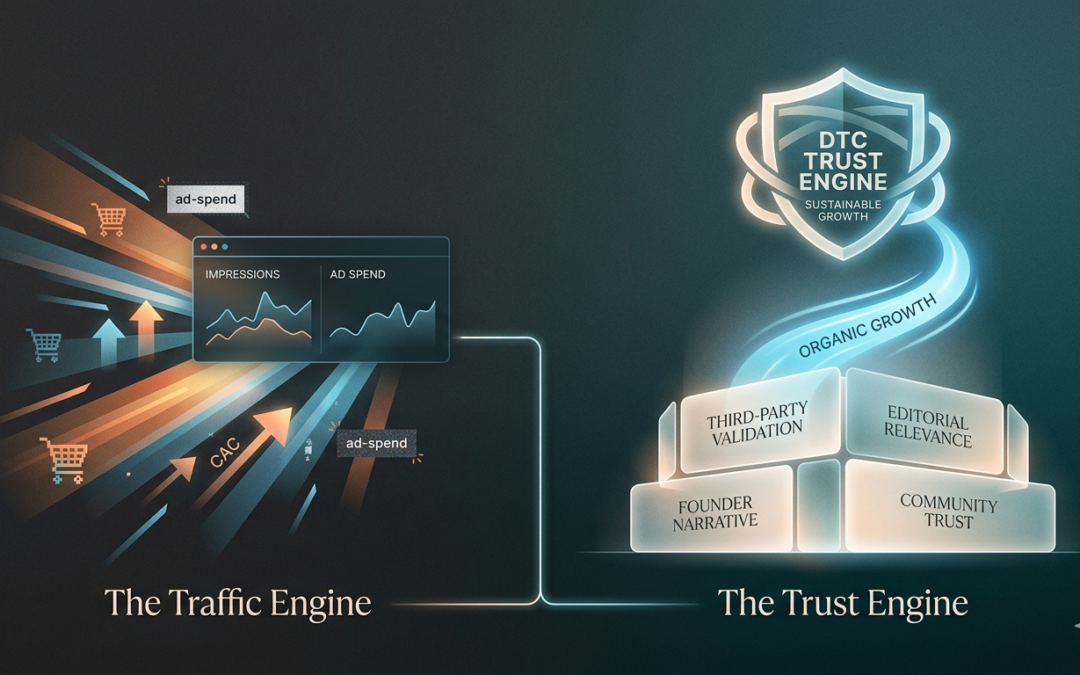
The Growth Problem Most DTC Brands Eventually Hit
Direct-to-consumer brands are often engineered for rapid traction. With performance marketing, influencer partnerships and conversion optimized landing pages, early growth can feel almost predictable. However, as scaling begins, a critical friction point emerges: attention does not equal trust. Brands start to notice rising customer acquisition costs, declining ad efficiency, and weaker repeat purchase behavior. This is not a failure of marketing execution; it is a structural limitation of relying too heavily on paid visibility. Consumers today are exposed to thousands of brand messages daily. They have developed a natural resistance to anything that feels overly promotional. This creates a trust deficit that no amount of ad spend alone can fix. At this stage, growth requires a shift from simply generating traffic to building credibility. This is where earned media becomes a strategic growth lever rather than a branding accessory. It transforms a brand from something people see into something people believe.
Paid media is inherently self referential. It is the brand talking about itself. Earned media, on the other hand, introduces third party validation, which significantly alters perception. When a brand is featured in a respected publication, discussed by a credible voice, or included in a relevant industry narrative, it gains an external stamp of legitimacy. This distinction is not subtle; it is behavioral. Consumers are far more likely to trust information that comes from independent sources. In DTC ecosystems, where skepticism is high and switching costs are low, this credibility advantage directly impacts conversion rates. A customer who discovers a brand through earned media often arrives with reduced hesitation and higher purchase intent. Over time, this translates into better unit economics, stronger brand recall, and improved customer lifetime value.
Moving Beyond Vanity Coverage to Strategic Placement
One of the most common inefficiencies in DTC PR is the pursuit of visibility without alignment. Not all coverage is equal, and not all press drives outcomes. A feature in a high profile outlet may appear valuable, but if it does not reach the right audience or reinforce the brand’s positioning, its impact remains limited.
Effective earned media strategy is grounded in precision. It prioritizes relevance over reach. This means identifying where your target customers consume information and ensuring your brand appears in those environments. It also requires developing angles that go beyond product promotion. Editors and journalists are not looking for advertisements; they are looking for stories. Brands that understand this distinction consistently outperform those that do not. Strategic placement is not about chasing headlines. It is about embedding the brand into conversations that already matter to its audience. This is what turns media coverage into a growth asset rather than a temporary spike in attention.
Narrative Is the Core Asset of High-Growth DTC Brands
At scale, products alone rarely differentiate a brand. Competitors can replicate features, pricing strategies, and even visual identity. What is significantly harder to replicate is a strong, coherent narrative. This includes the brand’s origin, its mission, its perspective on the category, and the problem it uniquely solves. Earned media plays a critical role in amplifying this narrative. It translates internal brand messaging into external recognition. A compelling founder story, a data backed insight, or a culturally relevant angle can position the brand as more than just a seller of goods. It becomes a participant in a broader conversation. This narrative advantage is particularly important in saturated categories such as wellness, beauty, and lifestyle products. In these spaces, consumers often choose brands that resonate with their identity and values, not just their functional needs. Earned media helps reinforce that emotional connection at scale.
The Compounding Effect of Trust on Growth Channels
Earned media does not operate in isolation. Its real value lies in how it enhances the performance of other channels. A brand that has credible press mentions typically experiences improved performance across paid advertising, email marketing, and organic social. This is because trust reduces friction at every stage of the funnel. For example, a customer who has seen a brand featured in a reputable outlet is more likely to click on its ads, spend time on its website, and complete a purchase. Similarly, press mentions can be integrated into landing pages, product descriptions, and retargeting campaigns to reinforce credibility. This compounding effect makes earned media one of the highest leverage investments for DTC brands. Unlike paid campaigns, which stop delivering value once spending ends, earned media continues to generate returns over time. It becomes part of the brand’s permanent credibility infrastructure.
Earned Media as a Driver of Search Authority
In today’s digital landscape, discovery is increasingly driven by search behavior. Consumers rarely make immediate purchase decisions. Instead, they research, compare, and validate before committing. This makes search presence a critical component of the customer journey. Earned media contributes significantly to this process. High quality mentions on authoritative platforms signal relevance and trustworthiness to search engines. Over time, this improves the brand’s visibility in search results, particularly for branded queries and category related keywords. More importantly, earned media shapes what potential customers find when they search. Instead of encountering only brand controlled messaging, they see independent validation, which strengthens confidence. This alignment between PR and SEO is no longer optional; it is essential for sustained growth in the DTC space.
What Effective Earned Media Looks Like in 2026
The nature of earned media has evolved. Traditional press releases and generic product pitches are no longer sufficient. Today, successful earned media is built on relevance, insight, and authenticity. It addresses real consumer concerns, aligns with current trends, and provides value to both editors and audiences. This may involve data driven storytelling, expert commentary, or positioning the brand within emerging cultural narratives. It may also include collaborations with credible voices who can introduce the brand in a natural, unscripted manner. The emphasis is on integration rather than interruption. Brands that adopt this approach do not just gain visibility; they earn attention in a way that feels organic and meaningful. This distinction is critical in an environment where consumers actively filter out anything that feels forced or inauthentic.
How AffordablePR Turns Earned Media Into a Growth Engine
At AffordablePR, we approach earned media with a clear objective: measurable business impact, not superficial visibility. We understand that for DTC brands, PR must function as a growth driver, not just a branding exercise. Our strategy is built on aligning media coverage with your target audience, your positioning, and your long term business goals.
We focus on crafting narratives that resonate, identifying media opportunities that matter, and securing placements that contribute to trust, not just traffic. More importantly, we ensure that every piece of coverage is integrated into your broader marketing ecosystem, amplifying its impact across channels. Our approach is data informed, strategically precise, and execution focused. We do not chase headlines for the sake of appearance. We build credibility systems that compound over time, helping your brand scale more efficiently and sustainably. For DTC brands looking to move beyond expensive customer acquisition and build lasting market presence, AffordablePR is not just a service provider. It is a strategic partner in growth.